I have a strong suspicion that the good Dr. Ibn al-'Adim lacks the "Mortal" aspect because he is a Long, and I suspect he is in fact the original Ibn al-'Adim (b. 1192.) The former is from Aleppo and (going by his commissions) has a particularly strong interest in the secret histories, while the latter was a historian from Aleppo.
An interesting lateral connection - per Wikipedia, the original Ibn al-'Adim’s writings are an important source on his contemporaries, the Naziri Ismaili cult of the Assassins or Hashishim. Haven’t we just heard something about cults of assassins recently? Ah, yes…
[quote=Anne Auclair] The Victory of Crowns
Card Text:Erratic accounts by one ‘Arun’, of the hunting and consumption of supposed immortals, by shadowy cults of assassins. Published in the late 19th century.
Study Text:The Assassins are, according to Arun, the agents of a power called the Coronel, a ‘soldier of the Secret Masters.’ The accounts go all the way back to Roman times.
Ending Text:Arun’s scholarship is dubious, but he (she?) writes pithily. Incidents of sudden and violent death are interspersed with aphorisms: ‘Hour’s don’t dream. Long try not to.’[/quote]
Studying the book on the Unburnt God has the outcome text "Jensen hypothesizes a pre-Zoroastrian fire deity, whose rites were the rites of smiths." This implies that the Unburnt God is another name for the Forge of Days.[/quote]
I agree with your conclusion. Somewhere in there (missing a cite for where I saw it) it also says that contrary to scholars’ expectations the fire deity appears to have been a Goddess rather than a God. So perhaps the Forge of Days is female, to the extent that powerful supernatural beings have a gender identity.
Oh, barter and favors for favors, probably. But the Hours and/or Names having their own sort of money isn’t completely out of the question. I mean, they live in a House after all. And humans use money all the time. Regular people use mundane currencies, while participants in the invisible world use spintrias. All this coinage must be a shadow or reflection of something.
Oh, barter and favors for favors, probably. But the Hours and/or Names having their own sort of money isn’t completely out of the question. I mean, they live in a House after all. And humans use money all the time. Regular people use mundane currencies, while participants in the invisible world use spintrias. All this coinage must be a shadow or reflection of something.[/quote]
It must be something only the hours care for. The Colonel it’s most likely the embodiment of the edge. By the very nature of his sphere I think he has to act neutral. Maybe he is a executor of sorts for being that try to step out of line or play the game wrong. But both rank office denote somebody of high power and leader but not the highest. Tip of spear going into this title is another interesting fact as well.
Studying the book on the Unburnt God has the outcome text "Jensen hypothesizes a pre-Zoroastrian fire deity, whose rites were the rites of smiths." This implies that the Unburnt God is another name for the Forge of Days.[/quote]
I agree with your conclusion. Somewhere in there (missing a cite for where I saw it) it also says that contrary to scholars’ expectations the fire deity appears to have been a Goddess rather than a God. So perhaps the Forge of Days is female, to the extent that powerful supernatural beings have a gender identity.[/quote]
Oh, right, I forgot to mention that. This being Hours it’s presumably some sort of incomprehensible complex property which merely happens to be analogous to something like gender, in roughly the same way that the Mansus is analogous to something like a House and so on. But insofar as we can talk about any properties of anything at that level, the Forge of Days is female.
Studying the book on the Unburnt God has the outcome text "Jensen hypothesizes a pre-Zoroastrian fire deity, whose rites were the rites of smiths." This implies that the Unburnt God is another name for the Forge of Days.[/quote]
I agree with your conclusion. Somewhere in there (missing a cite for where I saw it) it also says that contrary to scholars’ expectations the fire deity appears to have been a Goddess rather than a God. So perhaps the Forge of Days is female, to the extent that powerful supernatural beings have a gender identity.[/quote]
Oh, right, I forgot to mention that. This being Hours it’s presumably some sort of incomprehensible complex property which merely happens to be analogous to something like gender, in roughly the same way that the Mansus is analogous to something like a House and so on. But insofar as we can talk about any properties of anything at that level, the Forge of Days is female.[/quote]
If you’re going to slap a gender on to a forge female seems appropriate. Especially since it it creates. Maybe they are the womb of the world.
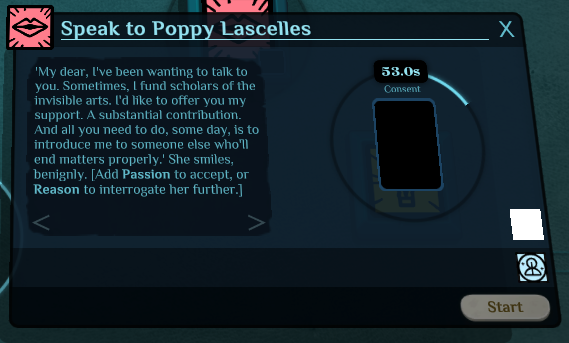
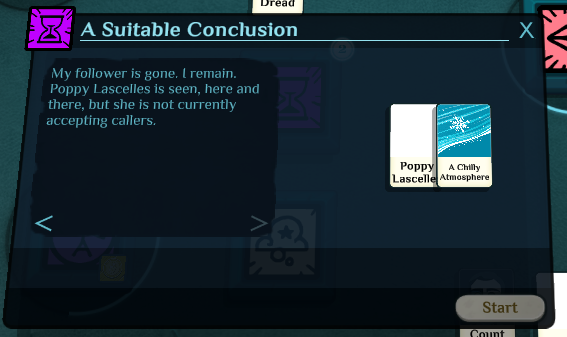
On Poppy Lascelles, I looked through the files to see if there’s a workaround for her being unusable and discovered there’s actually two versions of her in the files: poppy and poppyready. Apparently the patrons operate the same way–the "ready" ones you can speak to to get a commission, and the ones without "ready" you can’t; or in Poppy’s case, she acts like a regular acquaintance. Of course, when you’re introduced to Poppy, you’re given the wrong one. Spoilers for a bit of Poppy’s story (though I’m sure there will be more in later builds), in case any of you would rather wait for her to be properly fixed: (otherwise if you’d rather play it for yourself before it’s officially fixed, press the ~ key, type in poppyready, and press the +1 button)
[spoiler]
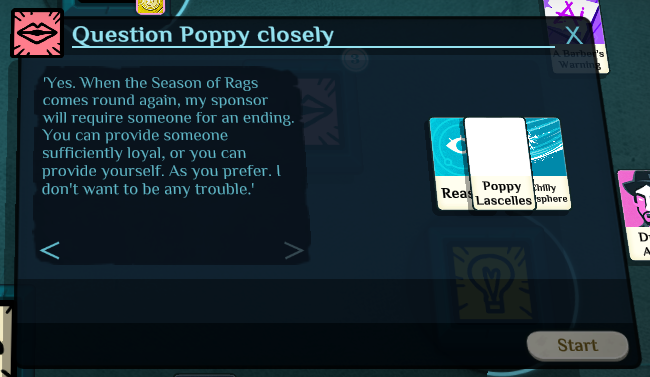
Questioning her further…
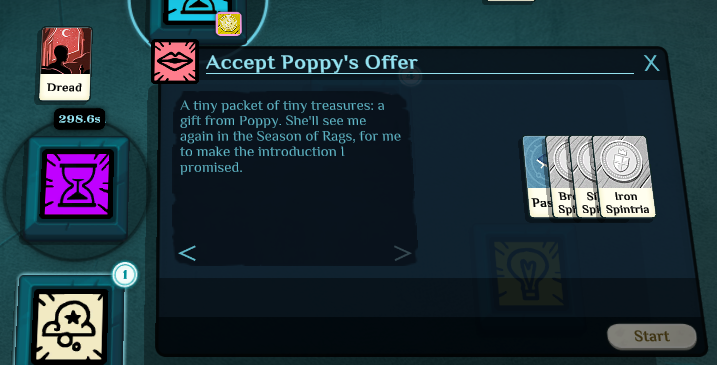
Speaking to her again, this time agreeing to her offer, gives one of each Spintria, which would help beginning Bright Young Things immensely while they’re waiting on gaining Reason to work for Glover & Glover. It also spawns the purple hourglass tile shown left, which just says "In the ‘Season of Rags,’ Poppy will return…"
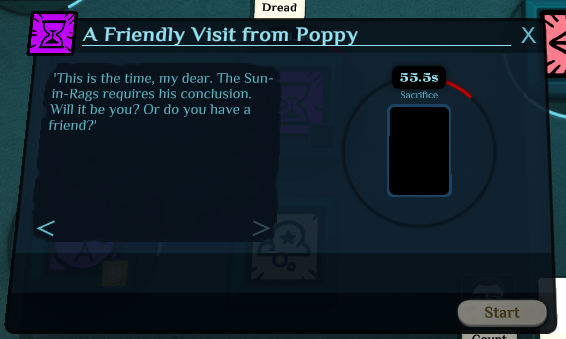
Once the timer hits 0, one of two things may happen: "Silence from Poppy," which just says "Poppy is seen around town, assisting at charitable events, smiling benignly." and restarts the 5 minute timer after 10 seconds. Or, "A friendly visit from Poppy…"
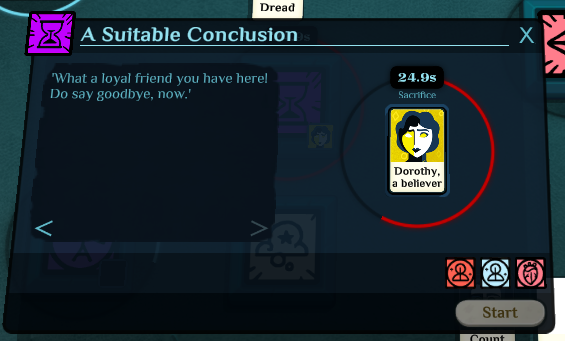
She requires a follower sacrifice.
Speaking to her afterwards is the same as talking to a regular acquaintance. Alternatively, if you don’t have any followers to offer… unfortunately, you are taken as a sacrifice to the Sun-in-Rags instead.
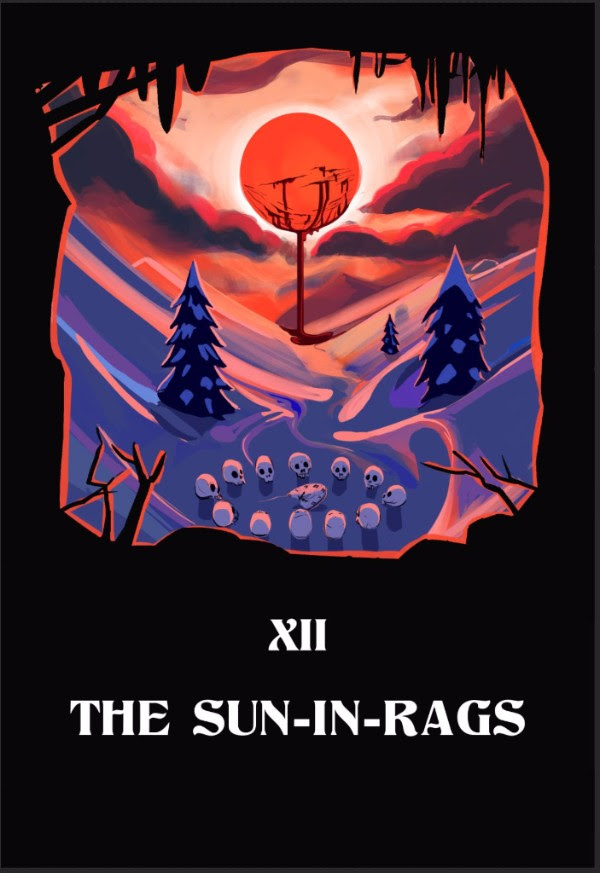
Side note: After reading some of the new books, and studying A Sexton’s Secret, I definitely agree that I was a bit hasty before in assuming the White is a new Hour, when new evidence now definitely implies it’s actually an alternate name for the Sun-in-Rags. :P edited by Alice Lutwidge on 12/20/2017
The story set-up and new locations for the Bright Young Thing really do a lovely job of suggesting the feel of the '20s decadent set, don’t they? It has very much the tone of early Evelyn Waugh, ‘Decline and Fall’ or ‘Vile Bodies’.
[color=rgb(194, 194, 194)]Did a bit of thinking, and think I gained a little Insight into the Forge of Days. [/color]
[color=rgb(194, 194, 194)]
Firstly, my opinion on the whole "is the Forge male or female" debate is that the FoD is whatever it feels like being at that time. As the god of constant change, it’s probably a safe bet that if it can be ever identified by a mortal concept like gender, it won’t stay stuck one way for long. [/color]
[color=rgb(194, 194, 194)]
[/color]
[color=rgb(194, 194, 194)]Going back and playing the prototype, [/color]recruiting followers using objects and lore affiliated with the FoD results in recruiting an anarchist. [color=#c2c2c2]I get the feeling that the Forge embodies a sort of primal anarchy, in that it ensures no one power remains dominant for long. While the Colonel and the Golden General are the Hours that demand conflict and conquest between peoples, maps are redrawn and empires rise and fall for the Forge. Countless nations and cultures have existed across the globe, never constant for long, always changing with time. The Forge might allow one great nation to dominate the globe for a time, but never indefinitely. Always it will eventually change the status quo, either through destruction, reduction, or by raising an new great nation to replace the current power.[/color]
[color=#c2c2c2]Strangely, the Forge seems to be willing to delay shifting the balance of power a certain way if given ample reason to. Case in point being how in one timeline a group of Long were able to convince it to let England rule the world for quite some time in the Age of Steel. In fact, from the beta it is all but stated the Forge of Days was considered to openly be the patron of England during the Age of Steel.[/color]
[color=#c2c2c2]
[/color]
[color=#c2c2c2]It seems that the name "Age of Steel" didn’t refer to an industrial age as much as it refereed to an Hour reforging England in it’s image the way a smith would shape a piece of steel. Additional text added to "A History of the War of the Roads" reveals that whatever the details of it were, deal the Long struck with the Forge seemed to have endowed the Royal Family with it’s power, turning them into the "Sovereigns of the Leashed Flame", who "destroyed or changed their enemies". The Sovereigns proceeded to effectively conquer the world and erect great cathedrals to "St. Spark" (three guesses who). However, after a time the price of the alliance with the Forge "began to take its toll". We’re not explicitly told the ending, but we can assume eventually they were unable to pay the Forge’s price for its support, leading it to turn on them and devour the Long. As is fitting of a god of anarchy, never on one side for long. [/color]
[color=#c2c2c2]
[/color]
[color=#c2c2c2]This new information is also interesting when considered alongside the new text the Queens of the Rivers and its implied connection to the other secret histories. If we assume the Queen of the Tagus being burnt alive is an allegory to the Forge of Days turning on and destroying the people of the Age of Steel, this might give insight into what went down in the other histories, and why exactly the past was rewritten again at some point. Now the question is whether the queens are a representative of the actual rulers of these histories, or for the societies as a whole? As either would have some intriguing connotations.
[/color]
if the Tagus had been an English river I’d feel a little more certain of that last part, but it’s still possible that the rivers aren’t supposed to correspond geographically to the events suggested.
I enjoy reading other peoples’ post-beta speculations. Here are some more:
The worst doom conceivable: The Man Who Liked Dickens, except that you’re also immortal.
Speculations on our new contacts Dr. al-Adim, Mme Bechet, and Count Jannings
Ibn al-Adim: Agree with everyone who thinks this guy is one of the Long, and given his interest in ‘overlooked histories’ (the sort of thing that gets you Excised), and the thing about ‘a newcomer to the city’ who has ‘fond memories of previous visits, long ago’, I’m a bit doubtful that he even originates from our own timeline (our al-Adim was an active diplomat into his late 60’s; this one looks younger). Why an immortal rogue historian would use his original name is another thing entirely and I’m going to invoke Plot Reasons here.
Count Gottlob Jannings: someone representing ‘a Continental confraternity of physicians and duellists’ sounds suspiciously like an agent or devotee of either the Cartographer of Scars or the Lionsmith, who are the most famous pair of duelling Hours in CS so far (though not the only ones: the Witch-and-Sister, or perhaps their unknown flipside the Sister-and-Witch, seem to have feuded with the Horned Axe as described in de Bellis Murorum).
Olympe Bechet: operates out of Kerisham, which is ‘located on the south coast of England, but is notoriously difficult to find’ – and likely to be the un-named seaside town that was the last known location of Teresa Galmier. Given the fact that Galmier made a visit to Port Noon and lived to tell the tale, people can perhaps travel between Noon and Kerisham when the conditions are right. At least it would explain why Bechet is running her highly-flavoured arcane Review from a backwater no-one can find.
Speculations on Kerisham and Port Noon:
Of these three people, who must be Know at least, I’m keenest on Mme. Bechet because the purpose and location of both Port Noon and Kerisham are interesting. Functionally Noon is a safe house for the Long, as described at length here. Geographically, it’s on the coast, like elusive Kerisham (except Noon is specifically on an ‘island’, and Kerisham more vaguely on the English South coast).
Etymologically, the name ‘Kerisham’ is linked to the idea of deer/stags/horn, and even anticipating the sort of clue shenanigans likely to occur in this game, it slightly boggles me that it was expected that Googling up the link between the ‘Hotel Ciervo’ that Galmier frequents in Noon, the name Kerisham, the existence of a Stag Door in the Mansus, and the ancient word-root ‘kerh–’, is something the player may possibly do.
The Stag Door connection will no doubt become clear in time. But because Noon has a Hotel Ciervo, I am inclined to infer wildly that Port Noon and Kerisham are in fact in the same place. Just not in the same History, and perhaps, in Noon’s case, not currently in any History at all.
We’ve also got references to the Sun’s “failed romance” with winter.
I’m not sure if Lascelles has any significance, but poppy flowers are typically affiliated with death. Also, it’s interesting that the SiR’s lore item is called a Sexton’s Secret. A sexton is an employee of a church in charge of the upkeep of sacred grounds, but the most common service they provide is the digging of graves.
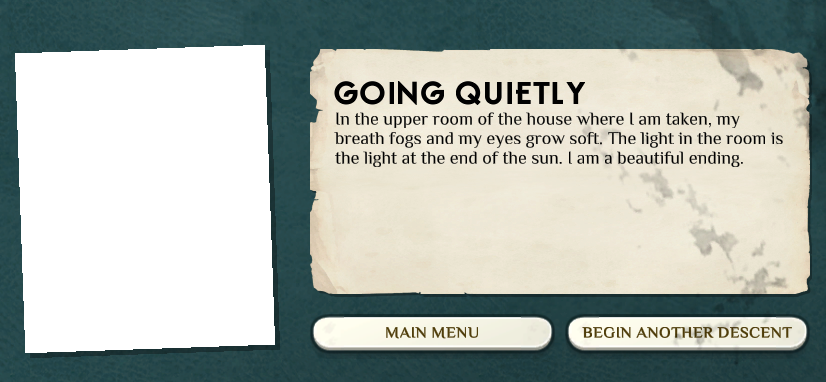
Yeah, it seems like the SiR has a lot in common with death. However, it’s interesting that when Poppy takes us away in one of the endings, we’re taken to the UPPER rooms of house. If death is down, why is the Hour of the end so close to the Glory?
[quote=Edward Warren]We’ve also got references to the Sun’s "failed romance" with winter.
I’m not sure if Lascelles has any significance, but poppy flowers are typically affiliated with death. Also, it’s interesting that the SiR’s lore item is called a Sexton’s Secret. A sexton is an employee of a church in charge of the upkeep of sacred grounds, but the most common service they provide is the digging of graves.
Yeah, it seems like the SiR has a lot in common with death. However, it’s interesting that when Poppy takes us away in one of the endings, we’re taken to the UPPER rooms of house. If death is down, why is the Hour of the end so close to the Glory?[/quote]
Death is only one type of end we’re getting what you are becoming a beautiful ending which is a form of ascending if I had to a guess.
[quote=Vexpont] Speculations on Kerisham and Port Noon:
Of these three people, who must be Know at least, I’m keenest on Mme. Bechet because the purpose and location of both Port Noon and Kerisham are interesting. Functionally Noon is a safe house for the Long, as described at length here. Geographically, it’s on the coast, like elusive Kerisham (except Noon is specifically on an ‘island’, and Kerisham more vaguely on the English South coast).
Etymologically, the name ‘Kerisham’ is linked to the idea of deer/stags/horn, and even anticipating the sort of clue shenanigans likely to occur in this game, it slightly boggles me that it was expected that Googling up the link between the ‘Hotel Ciervo’ that Galmier frequents in Noon, the name Kerisham, the existence of a Stag Door in the Mansus, and the ancient word-root ‘kerh–’, is something the player may possibly do.
The Stag Door connection will no doubt become clear in time. But because Noon has a Hotel Ciervo, I am inclined to infer wildly that Port Noon and Kerisham are in fact in the same place. Just not in the same History, and perhaps, in Noon’s case, not currently in any History at all.[/quote]
I’m not convinced that Kerisham and Port Noon are the same place. If anything, the names suggest the opposite. Like, the Hotel Ciervo on Mendicant Street is a place where the Long interact with visiting outsiders, presumably many of them Know. The Hotel is also but one part of the town, just as being a Know is presumably one part of the life of a Long. Kerisham’s name on the other hand is entirely synonymous with the Stag Door, while Mme. Bechet is a mortal. 1920s Kerisham also seems a bit less obscure than 1930s Port Noon - after all, a notorious literary journal is published in Kerisham. If Port Noon is a town of Longs, Kerisham is possibly a town of Knows.
So I know nakedly off-topic but because it’s Christmas how much do you think the Christ child or Santa Claus fit into occulta simulator lore. Which of the many histories?
He also gained a lot of wounds in order to pay for humanity’s sins. He also healed a lot of grievous ailments in life. Sounds more like the mother of ants to me.
Didn’t the priest of St Agnes of the Serpent outright refuse to bandage poor Sir William Hoare’s cut? She doesn’t strike me as that great of a healing deity.
Though I suppose with big events like Jesus it would make sense for there to be multiple powers involved in the production, so the point stands.
But seriously though, endings:
[quote=Matthew 24.1 - 24.3]As Jesus came out of the temple and was going away, his disciples came to point out to him the buildings of the temple. Then he asked them, "You see all these, do you not? Truly I tell you, not one stone will be left here upon another; all will be thrown down."
When he was sitting on the Mount of Olives, the disciples came to him privately, saying, "Tell us, when will this be, and what will be the sign of your coming and of the end of the age?"[/quote]
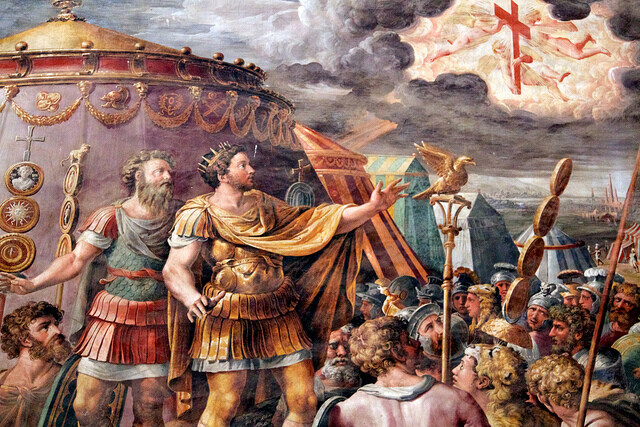
Another thing to take into account, Sol Invictus worshiping Constantine supposedly seeing a cross in the sun, of all places.
[Whispers] Hey, hey Constantine, hey - End Paganism. Just a suggestion. You’re looking great by the way.
[quote=Anne Auclair]Didn’t the priest of St Agnes of the Serpent outright refuse to bandage poor Sir William Hoare’s cut? She doesn’t strike me as that great of a healing deity.
Though I suppose with big events like Jesus it would make sense for there to be multiple powers involved in the production, so the point stands.
But seriously though, endings:
[quote=Matthew 24.1 - 24.3]As Jesus came out of the temple and was going away, his disciples came to point out to him the buildings of the temple. Then he asked them, "You see all these, do you not? Truly I tell you, not one stone will be left here upon another; all will be thrown down."
When he was sitting on the Mount of Olives, the disciples came to him privately, saying, "Tell us, when will this be, and what will be the sign of your coming and of the end of the age?"[/quote]
Another thing to take into account, Sol Invictus worshiping Constantine supposedly seeing a cross in the sun, of all places.
[Whispers] Hey, hey Constantine, hey - End Paganism. Just a suggestion. You’re looking great by the way.
. edited by Anne Auclair on 12/25/2017[/quote]
Definitely something I’ve transitioned it’s interesting day early church how to deal with the fact of how he died which was inglorious. It also go into the multiple histories each version of the gospels tells a different version of Christ. That’s not going in into the many other gospels that existed before the creation of the Bible. His death became a beautiful ending of a glorious beginning. Maybe he was a multiple hours project?