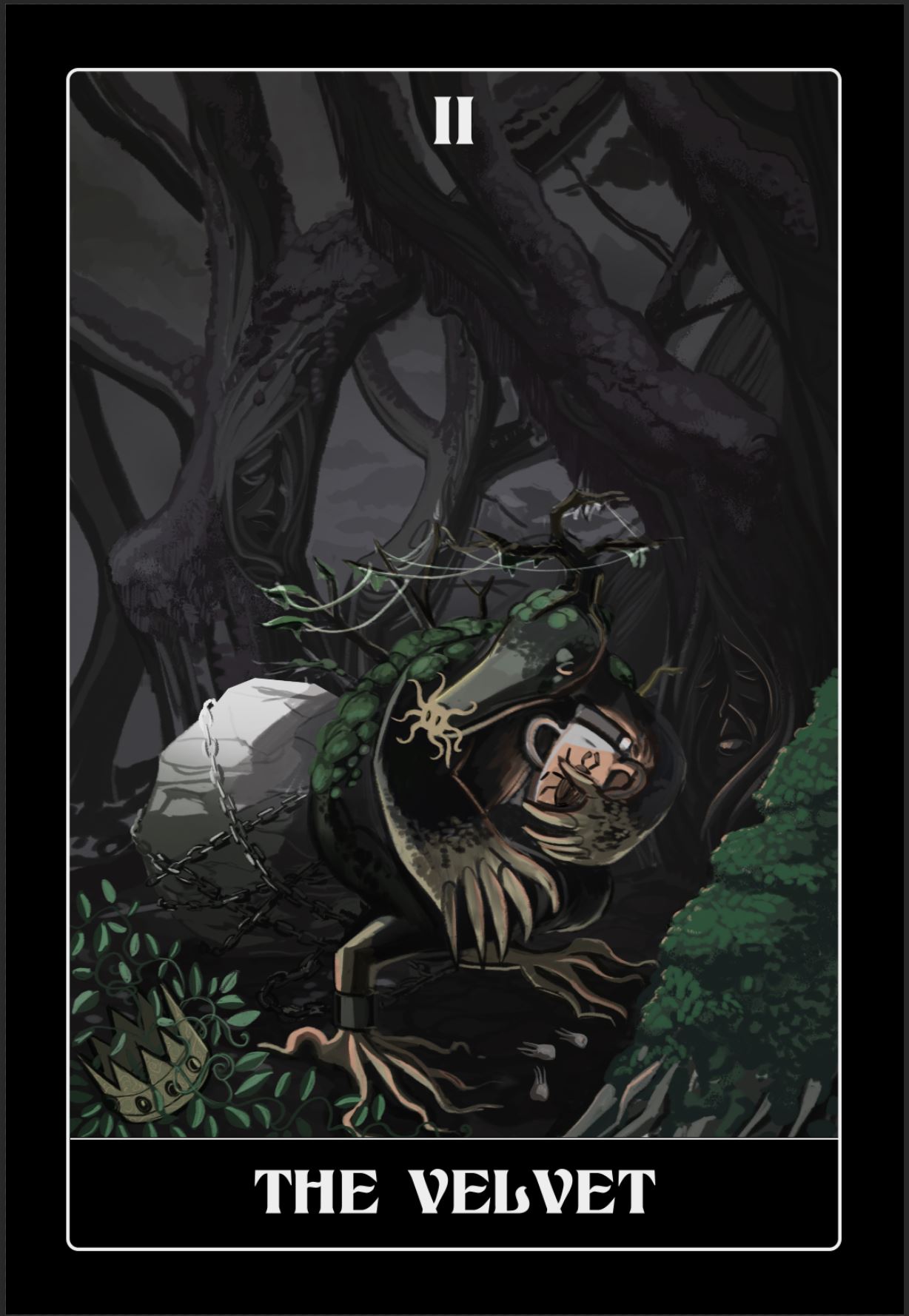
I’m also fascinated with this image - completely new, and there’s a lot to unpack there. Here’s a quick exegesis of some things I see in the iconography of the card:
We had it from elsewhere that Hour II is the Black-Flax, so "The Velvet" and "The Black-Flax" must be alternate names of the same thing, and it’s clearly in the Wood which also matches what we know from De Horis vol I.
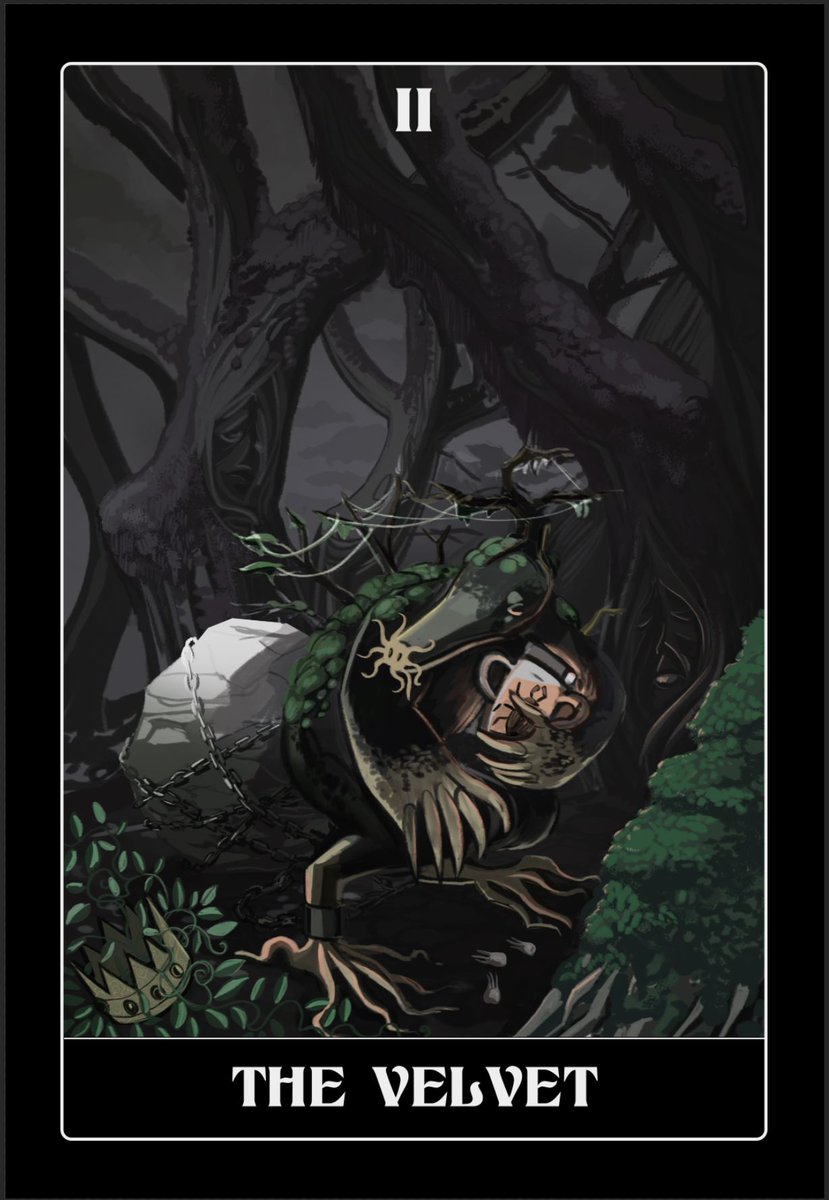
The central creature looks a little like an elongated version of a star-nosed mole - which themselves look like unearthly tentacled creatures * - with a mole’s enormous claws but with roots instead of its hind feet, and with branches of some kind growing out of its back, as well as moss growing on it. "Velvet" is a traditional description of a mole, so that fits.** I surmise that must be the Black-Flax itself, that it’s half plant and half animal in nature. There’s some kind of thread or web strung through its branches - flax thread, maybe? Or something else? It’s carrying some sort of vessel or urn with the symbol of a beetle on it, which perhaps contains a glowing liquid, cradled in its arms as if it’s trying to hide it.
"The Glory is a question…The Black-Flax’s answer is No, and that is always its answer.” Its leg appears to be heavily chained to a boulder, as if to keep it from rising or being lifted to the Glory. Looking closely at the surroundings, there are sad or tired faces in the trees - perhaps aspirants who’ve been imprisoned in or turned into trees to prevent their ascent?
The trees are also black and the surroundings are very dark - because it’s an hour of the night, maybe. There are discarded teeth on the ground, probably human teeth - this could be connected with the Barber’s Secret, since in ancient times barbers used to also be tooth-extractors. There’s a crown discarded on the ground, becoming overgrown with vines; this could again perhaps symbolize rejection of ascent, but there may be more to it than that. Finally, I could be imagining it, but it looks as though there might be a tiny pair of eyes in that shrub or bush, whatever it is in the lower right.
** Too good a tangent to resist: "[King William III’s] demise was the direct result of a fall from his horse which stumbled on a molehill, throwing its royal rider. …This is why, for many years afterwards, his Jacobite enemies would raise their glasses and toast ‘the little gentleman in the black velvet waistcoat’."
P.S. You guys are so far ahead of me in the game, it’s unreal. I’m still trying to figure out how to do much of anything new in this version, and my initial aspirant died rapidly due to that funds-consumption bug.
[quote=Anne Auclair]See,a crown, a bloody crown!!Pretentious, self-important elemental. Well, a mortal just summoned you and you’re going to provide background lighting for our little ceremony. How do you like that?!
I looked up your next screenshot. Many congratulations; the Baldomerian has not yet deigned to manifest for me.
[spoiler]That’s where she went, then. Or part of where she went, since she’s also Secret Histories. I wonder what Teresa Galmier’s timeline looks like (and why I’ve kept spelling her with an ‘H’ all this time). I also wonder what the price was to go as far as she did, because as well as being unmerciful, I suspect the Watchman of being jilted: he is sorrowful, and always in white. No Hour is safe of course, but I suspect he may be a particularly unsafe one for lovers to invoke.
At some point in 1927 Galmier perhaps visited Kerisham, apparently sane and human enough to not cause people to have her sectioned/flee in terror, though I guess you see some serious eccentrics in Kerisham. And there is that mysterious fourth book.
It’s all quite ominous, and I’m increasingly inclined to believe that when the game begins, Christopher Illopoly is deceased. I wonder if we can still meet him too, somehow? Is there some blend of Moth, Forge and Winter that would appeal? I doubt that even being rendered mute would shut the man up, he’d just communicate in irrepressibly sarcastic visions.[/spoiler]
NB If (like me) anyone is annoyed by Twitter’s default gargantuan image sizes, but also doesn’t want to immediately rehost original custom art just so as not to break the forums, image size is controlled by a suffix at the end of the URL, editable in html view. There aren’t many sizes: large, small, thumb, tiny, and orig/[no suffix] which is still pretty big usually. For example, the Velvet’s image can be altered like so:
Well, I’m not particularly ahead; I seem to play like the cultist version of Professor Branestawn. In recent news, Disciple Laidlaw gallantly expired in a horrific crucible explosion, and Inspector Wakefield waltzed in and snatched the still-smouldering corpse. He died a martyr for Knowledge, you awful jobsworth; of course I did not murder him. Also, I was going to use him for parts. edited by Vexpont on 3/1/2018 edited by Vexpont on 3/1/2018
That wasn’t my screenshot. The one with Baldomeria was someone else’s screenshot (it seems they used administrative tools). My screenshot was the one with King Crucible (and I managed to get him from playing the game fair and square!).
[quote=Clifton Royston][quote=Edward Warren]What is this~?
[/quote]
I’m also fascinated with this image - completely new, and there’s a lot to unpack there. Here’s a quick exegesis of some things I see in the iconography of the card:
We had it from elsewhere that Hour II is the Black-Flax, so "The Velvet" and "The Black-Flax" must be alternate names of the same thing, and it’s clearly in the Wood which also matches what we know from De Horis vol I.
The central creature looks a little like an elongated version of a star-nosed mole - which themselves look like unearthly tentacled creatures * - with a mole’s enormous claws but with roots instead of its hind feet, and with branches of some kind growing out of its back, as well as moss growing on it. "Velvet" is a traditional description of a mole, so that fits.** I surmise that must be the Black-Flax itself, that it’s half plant and half animal in nature. There’s some kind of thread or web strung through its branches - flax thread, maybe? Or something else? It’s carrying some sort of vessel or urn with the symbol of a beetle on it, which perhaps contains a glowing liquid, cradled in its arms as if it’s trying to hide it.
"The Glory is a question…The Black-Flax’s answer is No, and that is always its answer.” Its leg appears to be heavily chained to a boulder, as if to keep it from rising or being lifted to the Glory. Looking closely at the surroundings, there are sad or tired faces in the trees - perhaps aspirants who’ve been imprisoned in or turned into trees to prevent their ascent?
The trees are also black and the surroundings are very dark - because it’s an hour of the night, maybe. There are discarded teeth on the ground, probably human teeth - this could be connected with the Barber’s Secret, since in ancient times barbers used to also be tooth-extractors. There’s a crown discarded on the ground, becoming overgrown with vines; this could again perhaps symbolize rejection of ascent, but there may be more to it than that. Finally, I could be imagining it, but it looks as though there might be a tiny pair of eyes in that shrub or bush, whatever it is in the lower right.[/quote]On the topic of the crown, rejection - specifically rejection of self - is a running theme in Moth content. Higher-intensity Moth Influences and items speak with a possessive We, and the text given for becoming a Skintwister (meddling with either the Skin of the World or one’s own skin) is all about giving up oneself to the point you don’t even exist anymore:
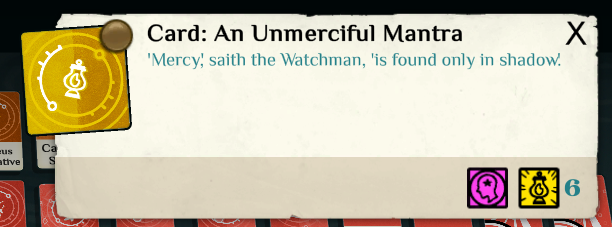
(Also, strangling the light, which means strangling the Glory. War against and deconstruction of the Glory and the Mansus are semi-common themes in Moth. The Ring-Yew is a force of renewal and growth, while the Forge of Days mercilessly transforms and destroys (Smith’s Secret uses the word ‘unmerciful’, and An Unmerciful Mantra brings up that ruthlessness itself is part-and-parcel for the Glory/Mansus, and that mercy may only be found in the Shadow - i.e. The Wood.)
There’s more to talk about in the rivalry, like the Witch-and-Sister/Sister-and-Witch contrasted with the Mother of Ants/Daughter of Venoms, the fact that ‘a power of the Wood enjoys a separation of the lock from the scalp’ in the context of all the sacrifice-demanding doors of the Mansus, and the focus on the forbidden nature of the Moth 14 lore (which I am not posting for the sake of intrigue. Feel free to shout if you want to see it.).
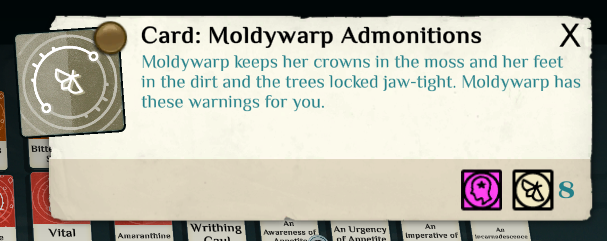
An interesting take on the matter comes up in Moldywarp’s Admonitions. (Moldywarp herself I am beginning to consider a Name of the Velvet now.)
Moldywarp, most notably, keeps her crowns in the moss, which strikes me as similar to the Skintwister’s oath of setting their clothes aside. The Velvet artwork, too, features a crown lying in some foliage, as well as trees and teeth (both invoked by the ‘trees locked jaw-tight’ phrase). Also, both the Admonitions and the Barber’s Warning being some of the only warnings to the player ties back into your theory about the Velvet’s connection to barbers-as-tooth-extractors.
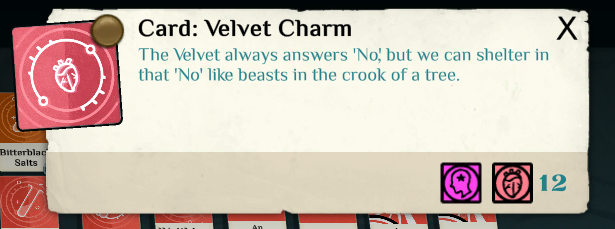
I’ll have to potentially disprove the tree-aspirants theory (and confirm Velvet = Black-Flax), though: The Velvet’s No is considered pretty safe as far as No’s go.
[quote=Vavakx Nonexus]On the topic of the crown, rejection - specifically rejection of self - is a running theme in Moth content. Higher-intensity Moth Influences and items speak with a possessive We, and the text given for becoming a Skintwister (meddling with either the Skin of the World or one’s own skin) is all about giving up oneself to the point you don’t even exist anymore:
(Also, strangling the light, which means strangling the Glory. War against and deconstruction of the Glory and the Mansus are semi-common themes in Moth. The Ring-Yew is a force of renewal and growth, while the Forge of Days mercilessly transforms and destroys (Smith’s Secret uses the word ‘unmerciful’, and An Unmerciful Mantra brings up that ruthlessness itself is part-and-parcel for the Glory/Mansus, and that mercy may only be found in the Shadow - i.e. The Wood.)
There’s more to talk about in the rivalry, like the Witch-and-Sister/Sister-and-Witch contrasted with the Mother of Ants/Daughter of Venoms, the fact that ‘a power of the Wood enjoys a separation of the lock from the scalp’ in the context of all the sacrifice-demanding doors of the Mansus, and the focus on the forbidden nature of the Moth 14 lore (which I am not posting for the sake of intrigue. Feel free to shout if you want to see it.).
An interesting take on the matter comes up in Moldywarp’s Admonitions. (Moldywarp herself I am beginning to consider a Name of the Velvet now.)
Moldywarp, most notably, keeps her crowns in the moss, which strikes me as similar to the Skintwister’s oath of setting their clothes aside. The Velvet artwork, too, features a crown lying in some foliage, as well as trees and teeth (both invoked by the ‘trees locked jaw-tight’ phrase). Also, both the Admonitions and the Barber’s Warning being some of the only warnings to the player ties back into your theory about the Velvet’s connection to barbers-as-tooth-extractors.
I’ll have to potentially disprove the tree-aspirants theory (and confirm Velvet = Black-Flax), though: The Velvet’s No is considered pretty safe as far as No’s go. [/quote]
I hadn’t gotten to any of these cards yet, but ‘Moldywarp’ is an older English word for a mole - as I observed ‘Velvet’ can be - so at this point I think we’re safe in saying ‘Moldywarp’ and ‘Velvet’ and ‘Black-Flax’ are all alternate names of the same hour, that she may take on the form of a mole, and that "her crowns in the moss and her feet in the dirt" are exactly what we’re seeing in that picture. edited by cliftonr on 3/2/2018
That Black-Flax card is incredibly interesting, especially since this is an Hour that we’ve had so little information about. Those faces on the trees seriously creep me out. When you explore the Wood in dreams now, you’ll occasionally get lines like "is that hair or hanging moss that caresses my face?". Take a close look at the Mansus map, particularly the bottom. Notice those weird caltrop looking things? Look closer and you’ll see that they’re made up of a jumble of human arms and legs.
That, combined with that vignette of the Wood with the Velvet, I am now entirely certain the Wood is at least partially made up of dead people. Brings to mind the Divine Comedy’s forest of suicides.
Tarot 2 is The High Priestess. This card represents wisdom, unconscious knowledge, and serenity/contentment.
The Velvet seems to be the antithesis of the Moth based on these attributes alone. The Moth is a restless little mote of Freudian ID obsessed reaching The Glory. The Velvet on the other hand is smart enough to know to stay the hell away from whatever it is that’s waiting for us up there.
That dappled mask card makes it clear that the branches of the Wood are interwoven so finely light from above can’t penetrate it. Perfect spot for an Hour that hates light to live, assuming it’s chained up by choice.
Moth Principle is about shedding traits, identity, skin, and eventually all sense of self in pursuit of ascension. The Velvet is a pack rat. It’s content to hoard it’s possessions to itself far out of sight of prying eyes. The fact it’s weighed down literally in addition to metaphorically is just the cherry on top of the metaphor.
I don’t want to dive too deep into the realm of speculation lest I risk losing the scent, but this is very reminiscent of a common theme in religion. The notion that one must shed worldly concerns and possessions to "ascend" in death is far too similar to the differences in The Moth and The Velvet to not mention in this context.
Oh yes, that bug has been a source of much consternation with me as well. A good tip to avoid it: the game no longer snatches cards out of your "hand". Whenever time is about to run out on the time passing card I pick up all my funds and hold it for a few seconds to make sure it doesn’t get sucked up. The card seems to work normally after that brief moment where it refreshes.
I’m still getting a handle of the new build myself, but I think I’ve done alright for myself so far. Below is my account of my current most successful playthrough of Adept’s Build. Beware, spoilers abound!
[spoiler] The best way I’ve found to play the game so far is either as an Adept or Physician. Bright Young Thing has some interesting story going on, but between Oliflame currently just being a potentially insanely more expensive version of Morlands and the lack of starting Reason, I steer clear.
Physician stars you off with a job and three Reason already, so it’s the quickest way to dive into the meat of the game without the initial startup period. Use the reason immediately to grind a senior position at glover and glover for maximum money gain, and insert reason into the temptation hook slot when it appears for some free Lore and starting Notion. Glimmering and Erudition can now be turned directly into Passion and Reason with gold now if you didn’t know, making those essays and poetry even more useless.
As a big fan of the Red Grail, I chose to go the way of the Sensation ambition. You get this ambition by dreaming about your current desire, then inserting Health. Then, you need to insert a piece of Grail lore to lock you in and set you on the next step. From there, you’re tasked with becoming a "master of the mansus" and learning a rite that can make you palatable to The Grail. The first step is to pass through the Mansus. Dreaming using lore will give you the Way: The Wood card. Next time you dream, first insert this card to progress to the White Door. And so on, and so on. Finally, you’ll reach the Stag Door, which will require you to answer a riddle continue. In the interest of being fair, I won’t mention the riddle or my answer. Alexis’ remarks on twitter suggest there are multiple riddles to the door and you get a different every playthough, but I haven’t played enough to confirm this.
After passing the Door, you are officially a Know. You’re now smart enough to be worth your patron Hour’s time. Now for the ritual.
It’s preferable for you to have already gathered a sizable following prior to attempting the rite, you’ll see why in a minute. During you journey to the Door you probably have some nice Lore stockpiled by now from all your cash. Studying Forge and Grail will create Rite of the Crucible Soul. This rite summons an Hour an allows it to inhabit your body, allowing you to share in their powers. This is how you get a Notion: Power victory without going full dedication to the Forge. But we’re not looking for power, the Grail will use the rite to… season us.
Pour as much Grail into the rite as you can and execute it. You’re not done yet though, as I was surprised to learn. Your Dedication:Sensation card is now Obsession: Sensation. You now bear The Third Mark. This is where your cultists come into play as the game suddenly becomes much more difficult. Over time the Mark begins to… alter you in the image of The Grail. You feel it’s endless hungers, and it compels you to do horrible things. Now in addition to dealing with the Suppression Bureau, you’ll occasionally need to eat either prisoners, corpses, or "lunatics" (which I could not find anywhere, leading me to believe they’re not in the game yet. Fail to eat someone when the urge arises and you’ll start to eat yourself, draining Passion.
Examining the Rite of the Crucible Soul reveals the Ultimate Goal of the Sensation aim is to gain the Seventh Mark: The Feast of the True Birth. But first you’ll need to find and receive the Sixth Mark and…
… And this is where the wheels came off and I had to restart. The random number gods were not kind to me, and the followers in charge of getting me tools and corpses all constantly came back empty-handed then eventually not at all. I ate my best disciple in order to power the Rite, thinking I’d win right there only to learn there was more game to play. And that damnable Wakefield managed to best every cultist and plant-zombie I threw at him again and again. The Surpression Bureau is secretly in bed with The Colonel I swear.
So, if anyone could point me in the direction of the Sixth Mark so I can complete my unholy ascension and become a full-fledged inhuman abomination intent on devouring all that is good and decent, I’d really appreciate it! [/spoiler]
[quote=Edward Warren]That Black-Flax card is incredibly interesting, especially since this is an Hour that we’ve had so little information about. Those faces on the trees seriously creep me out. When you explore the Wood in dreams now, you’ll occasionally get lines like "is that hair or hanging moss that caresses my face?". Take a close look at the Mansus map, particularly the bottom. Notice those weird caltrop looking things? Look closer and you’ll see that they’re made up of a jumble of human arms and legs.
That, combined with that vignette of the Wood with the Velvet, I am now entirely certain the Wood is at least partially made up of dead people. Brings to mind the Divine Comedy’s forest of suicides.
Tarot 2 is The High Priestess. This card represents wisdom, unconscious knowledge, and serenity/contentment.
The Velvet seems to be the antithesis of the Moth based on these attributes alone. The Moth is a restless little mote of Freudian ID obsessed reaching The Glory. The Velvet on the other hand is smart enough to know to stay the hell away from whatever it is that’s waiting for us up there.
…
[/quote]
Good call on the High Priestess connection - I had been thinking about that myself and almost brought it up! Particularly in the context that The Black-Flax seems to be trying to conceal that container of something that she has clutched to her body, which is part of the role of the High Priestess.
Come to think of it, compare The Velvet card more closely to the Waite-Rider iconography for the High Priestess:
The Velvet is holding the container against her body as the Priestess does the scroll; she’s between two trees, paralleling the two columns; and her crown is on the ground as is the Priestess’s golden moon. I think some of these must be intentional visual references.
Has anyone been able to create the rite of the Watchman’s Sorrow? I keep researching A Watchman’s Secret with a Smith’s Secret, but the game acts like these two are incompatible… edited by Anne Auclair on 3/2/2018
[quote=Anne Auclair]Has anyone been able to create the rite of the Watchman’s Sorrow? I keep researching A Watchman’s Secret with a Smith’s Secret, but the game acts like these two are incompatible… edited by Anne Auclair on 3/2/2018[/quote]There’s a bug that makes Watchman’s Sorrow rite impossible to create via Studying. You pretty much have to either summon it in with the dev console or just use one of the other nine.
The Rite of the Watchman’s Sorrow is actually, for some reason, Grail + Forge. The first time you study the two you’ll get the Rite of the Crucible Soul; study them again and you should get Watchman’s Sorrow. I was (surprisingly, to me) able to create both without using dev commands.
[quote=Edward Warren]
The Velvet seems to be the antithesis of the Moth based on these attributes alone. The Moth is a restless little mote of Freudian ID obsessed reaching The Glory. The Velvet on the other hand is smart enough to know to stay the hell away from whatever it is that’s waiting for us up there.
That dappled mask card makes it clear that the branches of the Wood are interwoven so finely light from above can’t penetrate it. Perfect spot for an Hour that hates light to live, assuming it’s chained up by choice.
Moth Principle is about shedding traits, identity, skin, and eventually all sense of self in pursuit of ascension. The Velvet is a pack rat. It’s content to hoard its possessions to itself far out of sight of prying eyes. The fact it’s weighed down literally in addition to metaphorically is just the cherry on top of the metaphor.
I don’t want to dive too deep into the realm of speculation lest I risk losing the scent, but this is very reminiscent of a common theme in religion. The notion that one must shed worldly concerns and possessions to "ascend" in death is far too similar to the differences in The Moth and The Velvet to not mention in this context. [/quote]
The Black Flax might not be so much opposed to the Moth as symbiotic or parasitic. Think about it, the reason the Woods is so dark, so relatively free of the Glory’s Light, is because the Trees reach for that Light and, as trees do, create a dense canopy that darkens the forest floor. So it is the questing for the light that creates the very darkness that the Velvet values.
The Moth is all about cutting away your false identities, possessions, and forms. Well, if those things are being discarded, then they are available for someone else to gather up, collect, use, and horde, right? Notice how the Flax, on closer inspection, seems like such a miscellany of random, contradictory things. So the Black Flax doesn’t really get anything out of actively opposing the Moth’s desire for the Glory. Instead, it profits from it.
The symbiotic reading of this relationship would be the Velvet’s scavenging removes the temptation for resuming what was abandoned. Or maybe he creates a collection that others can use – it’s implied the path to giving up your identity/possessions is switching them around and realizing just how interchangeable, and hence meaningless, they really are ("Oh, the friends that we played and the skins that we made"). The parasitic reading is that the Velvet is just a thief or pack-rat who is grabbing things for its own purposes.
. edited by Anne Auclair on 3/3/2018
You can learn a little bit about the Hours from how they are paired together in the Society Dedication descriptions.
(Lantern) Watchman & Flowermaker
(Moth) Moth & the Witch-and-Sister
(Grail) Red Grail & the Sister-and-Witch
(Forge) Forge of Days & Madrugad
(Heart) Thunderskin & Velvet
(Knock) Mother of Ants & Meniscate
(Winter) Sun-in-Rags & Horned Axe
(Edge) Colonel & Lionsmith
Now, this isn’t close to a complete list, there are only 16 Hours accounted for here and all the descriptions contain "…among others." Also, just because two Hours are paired together that does not mean they are friends or allies; the Colonel and the Lionsmith are anything but. This pairing only means that these are the Hours most important to a particular principle. There’s also a fair amount of overlap - the Velvet and Horned Axe are Hours of the Wood, while the Meniscate is probably a god-from-light (Glassmaker’s Toxin, which is important to the Meniscate, is a Lantern ingredient, and the Holy Wound’s Oath mentions a goddess who came from light), the Lionsmith seems pretty close to the Forge, and the Twins are also involved with Knock and Heart and maybe even Edge…they’re kinda all over the place.
The Velvet being paired with the Heart suggests that it’s hording in the Wood is not done to help the Moth, but maybe lead people away from the Moth’s stripping away of everything through the opposite approach: accumulation of identities, forms, flesh. Such would obviously help maintain the skin of the world, which is what the principle of the Heart is all about. Whenever your character is clearly losing it, they take shelter in memories of happier times and their diaries, which reestablishes a sense of self.
btw, I found another book! Well, it’s title anyway. When you learn Aramaic from Dr. Ibn al-Adim, you get the following text:
The language of the Visions of Amram, of the Book of Daniel, of the Account of Kanishk at the Spider’s Door.
Imprimis, Cultist Simulator won the Emotional Games best game design award last night, before even being completed. Woo!
Secundus, a fresh tweet from Alexis last night a little before that says "this one goes out to the most feverishly theorising #cultistsimulator enthusiasts". That would be us! It offers hints on new Lore content with a snippet from his magic spreadsheet:
The bits visible in the left column suggest that that column is locations - seems to contain the tail end of the words "[Treach]erous Ground", "[pl]ains", "[d]esert", "sea", "[something] Door" as well as several without enough letters to guess at. My guess is that each row has the name of a different type of artifact in a column off somewhere to the left of this excerpt, and these are the locations where we might find these types of artifacts while Exploring, and their associated Lore Aspects.
I find it particularly interesting that everything here has two different Aspects - some of you may remember that was true of the Noonstone, the one powerful artifact you could find in the initial web game prototype, which had a lot of both Forge and Grail power to it.
Well, summons have multiple principles - it’s one of the things that makes them so useful. Really, really hard to get artifacts would presumably have similar features. Alternatively, it could be a list of which locations are connected to which Principles. The Ecdysis Club is both Moth and Grail (primarily Moth, hence the name) and it gives you Moth and Grail Influence. But trying to guess an incomplete spreadsheet (especially one so clearly photographed to be as cryptic as possible) seems like the road to madness :P
Makes sense that the Mansus will be divided into different areas. I’d assume that once Mansus exploration is added to the game, we’ll be able to use the Way cards to determine which part of the Mansus we want to visit each night. Notice that on the early Mansus map certain locations are directly lined certain doors. We’ll have to pick which Hour or Area we want to contact each night. Otherwise any amateur could start at the Wood and climb to the Stag Door in a single night.
I have to say that I’m looking forward to the Mansus exploration expansion with baited breath. The Catherine Unger art of different rooms and the unique interface complete with map have me hoping Alexis and co. have something more immersive than cards in store for us, something along the lines of HoMD. I’ve been loving the game so far, but it’s my nightmare that exploring the Mansus for ritual ingredients will boil down to clicking on a part of the map, then getting sent back to the regular card table and getting a card that says "Tonight I dreamed of the domain of Hour insert name here, insert sentence detailing surroundings here. While I was there I tripped over a rock and found insert ingredient name here. Then I woke up." I know Alexis won’t let us down!
…Also, look at the section of the Mansus Map containing The Bounds. I just noticed something weird about them after I saw the shudder limb-trees in the Wood. Is it just me… or are those flying cats?
How long until I can summon a swarm of those to kill Wakefield, Alexis?
That wasn’t my screenshot. The one with Baldomeria was someone else’s screenshot (it seems they used administrative tools). My screenshot was the one with King Crucible (and I managed to get him from playing the game fair and square!).[/quote]
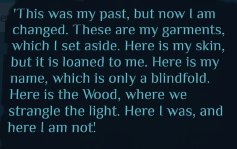
In hindsight, the esoteric Cultist called ‘Butts’ should have tipped me off that the summoner probably wasn’t you, but I guess the Baldomerian’s identity wasn’t a 100% unexpected revelation. Clifton Royston’s reminder that the Watchman says that ‘Mercy is only found in shadow’ is nasty, though. Spoilers up:
[spoiler]I feared for Galmier and Illopoly from the day the Door in the Eye card appeared. And this is her description, when you finally meet her as a Name of the Lantern:
"The Baldomerian has the hunched shoulders of a scholar, the clear voice of a school-teacher, and the freckles of a traveller on the Continent. She lacks a shadow."
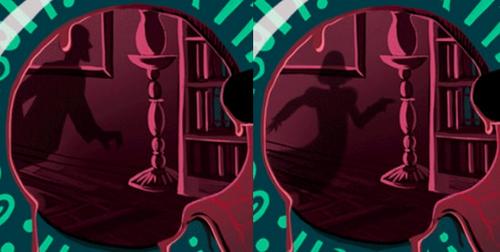
She has no shadow. And no shadow = no mercy. Oh, no. Nonono. I fear that this is probably the last known image of Teresa’s shadow:
[/spoiler]
[quote=Anne Auclair]You can learn a little bit about the Hours from how they are paired together in the Society Dedication descriptions…
(Forge) Forge of Days & Madrugad
(Knock) Mother of Ants & Meniscate[/quote]
More from 'Cultist Simulator: Everything you wanted to know about pre-classical deities, but were afraid to ask Count Jannings in case he starts saying things like ur-mythos and chaoskampf’:
‘Madrugad’ – This title is adapted (I think) from a Portuguese verb, madrugar (to dawn, or get up at first light), but etymologically, it comes from Latin ‘maturare’, which means: to ripen/to hasten. The closest English word is probably the uncommon ‘matutinal’ – ‘pertaining to the dawn’.
Naturally, there is an obscure pre-classical Italic deity at the bottom of this: the Mater Matuta, who was originally a goddess of ripening grain, but by Roman times was a Dawn deity just because the Romans were Lumpers rather than Splitters where deities were concerned, and if a god was half-forgotten, they’d just identify them with a vaguely similar candidate from their current pantheon (in this case, Aurora). Nevertheless, the identification is old enough for the ‘matu*’ root to now mean both ‘ripen’ and ‘dawn’ in many languages.
It’s kind of tempting to conclude from this that The Cleansing Dawn could potentially be an actual Hour, but I’m a bit wary since the Unflinching Order (who venerate the Madrugad) are Forge, and the Lore from The Cleansing Dawn nightmare is Lantern.
‘Meniscate’ – much easier to tackle, and from Greek, where ‘meniskos’ means ‘crescent-shaped’ (literally ‘little moon’). There must be a lunar Hour in there somewhere but I don’t think we’ve met it yet. I wonder it it’s connected to Mirrors somehow?
[quote=Edmund Warren]That Black-Flax card is incredibly interesting, especially since this is an Hour that we’ve had so little information about. Those faces on the trees seriously creep me out. When you explore the Wood in dreams now, you’ll occasionally get lines like "is that hair or hanging moss that caresses my face?". Take a close look at the Mansus map, particularly the bottom. Notice those weird caltrop looking things? Look closer and you’ll see that they’re made up of a jumble of human arms and legs.
That, combined with that vignette of the Wood with the Velvet, I am now entirely certain the Wood is at least partially made up of dead people. Brings to mind the Divine Comedy’s forest of suicides.[/quote]
Yeah, you don’t just accidentally-in-passing slip in a reference to one of its most famous scenes in The Inferno. I don’t think the parallel to the Wood of the Suicides is exact, but it seems likely to me as well that the trees of the Wood beneath the Mansus were once human dreamers; maybe they lingered there too long, in a helpless state of madness or terror, like the one Parsifal found himself in after his botched attempt to pass the White Door. In The Inferno, the trees must be wounded in order to speak, and the trees of the Wood are ‘scar-barked’. The charmers that patrol it are surely these things:“a horrible assemblage of limbs, like the Isle of Man triskele crossed with Hellraiser”. I wonder if they are a literal result of The Sleep of Reason Produces Monsters, or if they too were once human; perhaps dropping to all fours to duck under branches in the Wood is very inadvisable.
I’m not sure if anyone noticed it yet, but there’s a new post on the weather factory website detailing the design process for the Mother of Ants.
A few important points to take away:
There’s a SUPER SECRET reason she’s called the Mother of Ants[/li][li]The snake motif in her image originates from Medusa. Might also be why she’s chopping her own head off. [/li][li]Blood snakes were originally supposed to be coming out of her neck, but Lottie thought it would make her look like a lady snake pinata.[/li][li]Alexis wanted her card to have purple colors to go with the Knock. Her second name?[/li][li]Her expression and perhaps design are based on a pissed looking girl from the movie Seven Chances starring Buster Keaton!
My Brothers and Sisters in the Invisible arts! I give you the Mother of Ants: animated!
In mythology, Medusa’s blood turned into coral when combined with seaweed. Witch-and-Sister anyone? It also spawned poisonous vipers, and the Amphisbaena, aka the Mother of Ants.
Also, Lady Snake Pinata is her (un)official third name for me now. edited by Edward Warren on 3/4/2018


 [/spoiler]